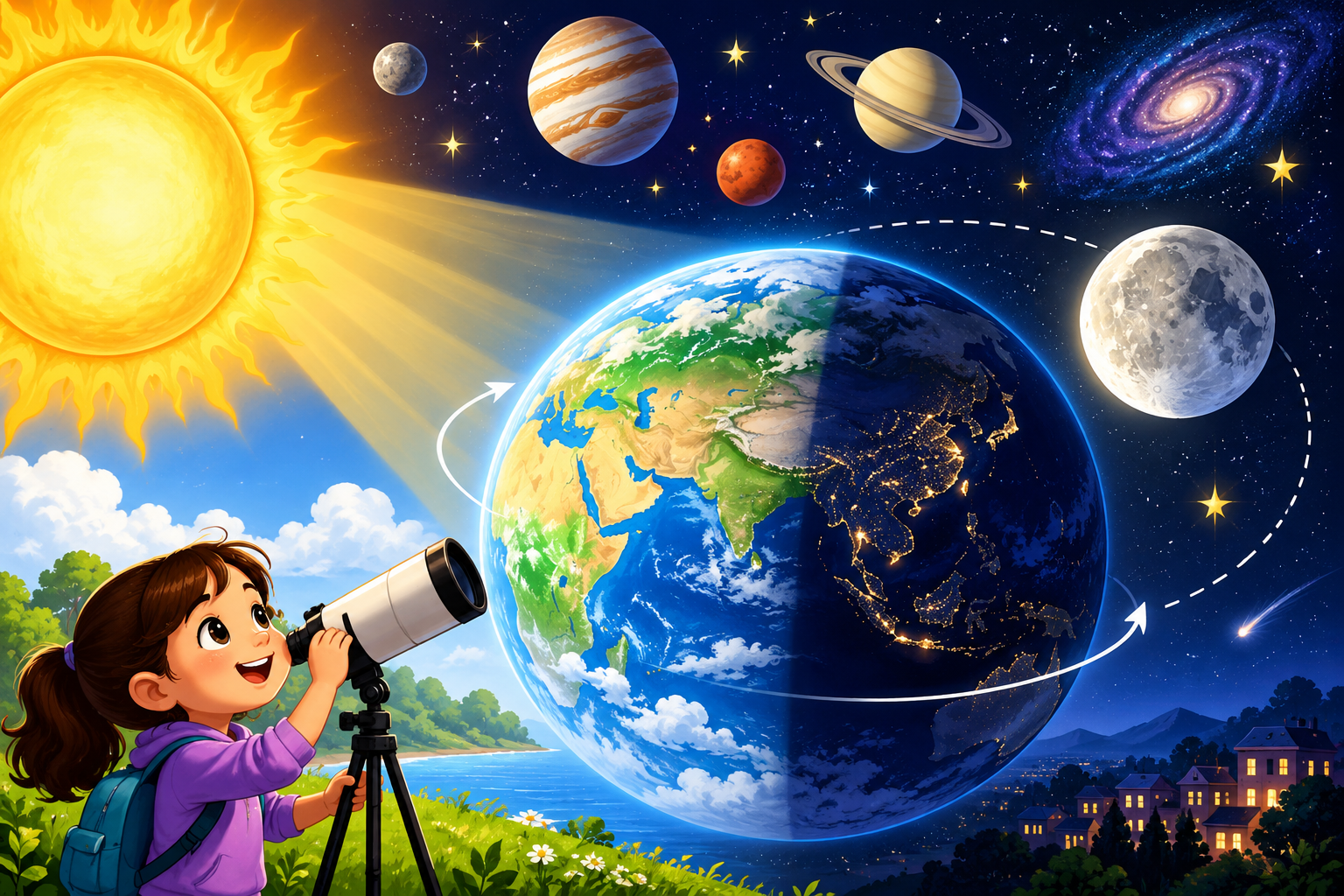
We already know that the Sun gives Earth light and warmth. But there is much more to discover!
The Sun has layers, powerful magnetic fields, enormous eruptions and a huge atmosphere that stretches far into space.
Let’s take a closer look at our amazing star. 🔭☀️
🔥 What Is Inside the Sun?
The Sun is not solid like Earth. It is made mostly of hydrogen and helium in an extremely hot state called plasma.
Deep inside the Sun, the temperature and pressure are enormous. Hydrogen nuclei join together in a process called nuclear fusion.
This is where the Sun’s energy begins. 🌟
📝 SCIENCE NOTE
The Sun is not a solid ball. It is made mostly of extremely hot hydrogen and helium.

Sun’s Layers
🧅 The Sun Has Layers
The Sun has several layers, and each one has a different job.
Think of it like a giant onion with layers inside and outside!
🔥 1. The Core
The core is the very centre of the Sun.
This is where nuclear fusion takes place and enormous amounts of energy are produced.
🌡️ 2. Radiative Zone
Energy moves outward through this very dense layer.
🌊 3. Convection Zone
Here, hot material rises while cooler material sinks.
These movements help carry energy toward the Sun’s surface.
☀️ 4. Photosphere
The photosphere is the layer we usually see as the Sun’s visible surface.
Sunspots appear on this layer.
🌈 5. Chromosphere
The chromosphere lies above the photosphere.
It can appear reddish during a total solar eclipse.
👑 6. Corona
The corona is the Sun’s enormous outer atmosphere.
It extends far into space and can reach temperatures of millions of degrees Celsius.
Does the Sun Rotate?
Yes!
The Sun spins around its own axis, just like Earth does.
But there is something surprising.
Because the Sun is made of plasma, different parts of it rotate at different speeds.
The region around its equator takes about 25 days to rotate once, while areas closer to the poles take longer.
📝 DID YOU KNOW?
The Sun does not rotate like a solid ball. Its equator rotates faster than regions near its poles!

The Sun Rotates
🧲 The Sun Has a Giant Magnetic Field
The Sun is a gigantic magnetic powerhouse.
Moving plasma inside the Sun creates a powerful magnetic field.
Sometimes these magnetic fields become twisted and tangled.
When magnetic energy is suddenly released, spectacular solar activity can occur.
📝 LOOK CLOSELY!
Those beautiful loops above the Sun are connected to its powerful magnetic field.

The Sun’s Magnetic Field
💥 What Is a Solar Flare?
A solar flare is a sudden, powerful burst of energy from the Sun.
Some solar flares can release enormous amounts of energy in a very short time.
Solar flares are connected to changes in the Sun’s magnetic fields.
The Sun can also release huge clouds of charged particles called coronal mass ejections, or CMEs.
Strong solar activity can sometimes affect satellites, radio communication and other technology.
🔥 WOW!
The Sun can suddenly release an enormous burst of energy!

Solar Flares
The Sun Is Always Sending Particles Into Space
The Sun doesn’t simply sit quietly in space.
It constantly releases a stream of electrically charged particles called the solar wind.
The solar wind travels throughout the Solar System.
Earth’s magnetic field helps protect us from much of this solar activity.
✏️ REMEMBER
Solar wind = a stream of charged particles flowing outward from the Sun.

Sun → Solar Wind → Earth
🌈 When the Sun Paints the Sky
Sometimes particles from the Sun interact with gases in Earth’s upper atmosphere.
This can create one of nature’s most beautiful sights:
🌌 The Aurora!
In the Northern Hemisphere, it is called the aurora borealis, or Northern Lights.
In the Southern Hemisphere, it is called the aurora australis, or Southern Lights.
📝 DID YOU KNOW?
The beautiful aurora is connected to activity from our Sun!

Solar Wind and the Aurora
👑 Why Is the Corona So Strange?
The Sun’s corona is its enormous outer atmosphere.
Here’s something surprising:
The visible surface of the Sun is about 5,500°C, while parts of the corona can reach millions of degrees Celsius.
Scientists are still studying exactly how the corona becomes so incredibly hot.
During a total solar eclipse, the bright photosphere is blocked by the Moon, allowing the delicate corona to become visible.
🤔 A SUN MYSTERY
Why is the Sun’s outer atmosphere so much hotter than its visible surface?
Scientists are still working to fully understand this mystery.

The Sun’s Corona During a Total Eclipse
⏳ How Old Is the Sun?
The Sun is approximately 4.6 billion years old.
That’s an almost unimaginable amount of time!
For billions of years, the Sun has been shining at the centre of our Solar System while the planets travel around it.
And the Sun still has a very long future ahead.
🔮 What Will Happen to the Sun One Day?
The Sun will not shine forever.
In about 5 billion years, after using much of the hydrogen in its core, the Sun will begin to change.
It will expand into a huge red giant.
Much later, it will shed its outer layers and eventually become a white dwarf.
Don’t worry—these changes are billions of years away! 😊

The Sun’s Life Cycle
🌍 Why Is the Sun So Important to Earth?
The Sun does much more than brighten our daytime sky.
Its energy helps:
☀️ Warm Earth’s surface
🌱 Plants make food through photosynthesis
🌊 Drive Earth’s water cycle
🌬️ Influence weather and climate
🌍 Provide energy that supports life
Without the Sun’s energy, Earth would be a very different place.
🌟 DID YOU KNOW?
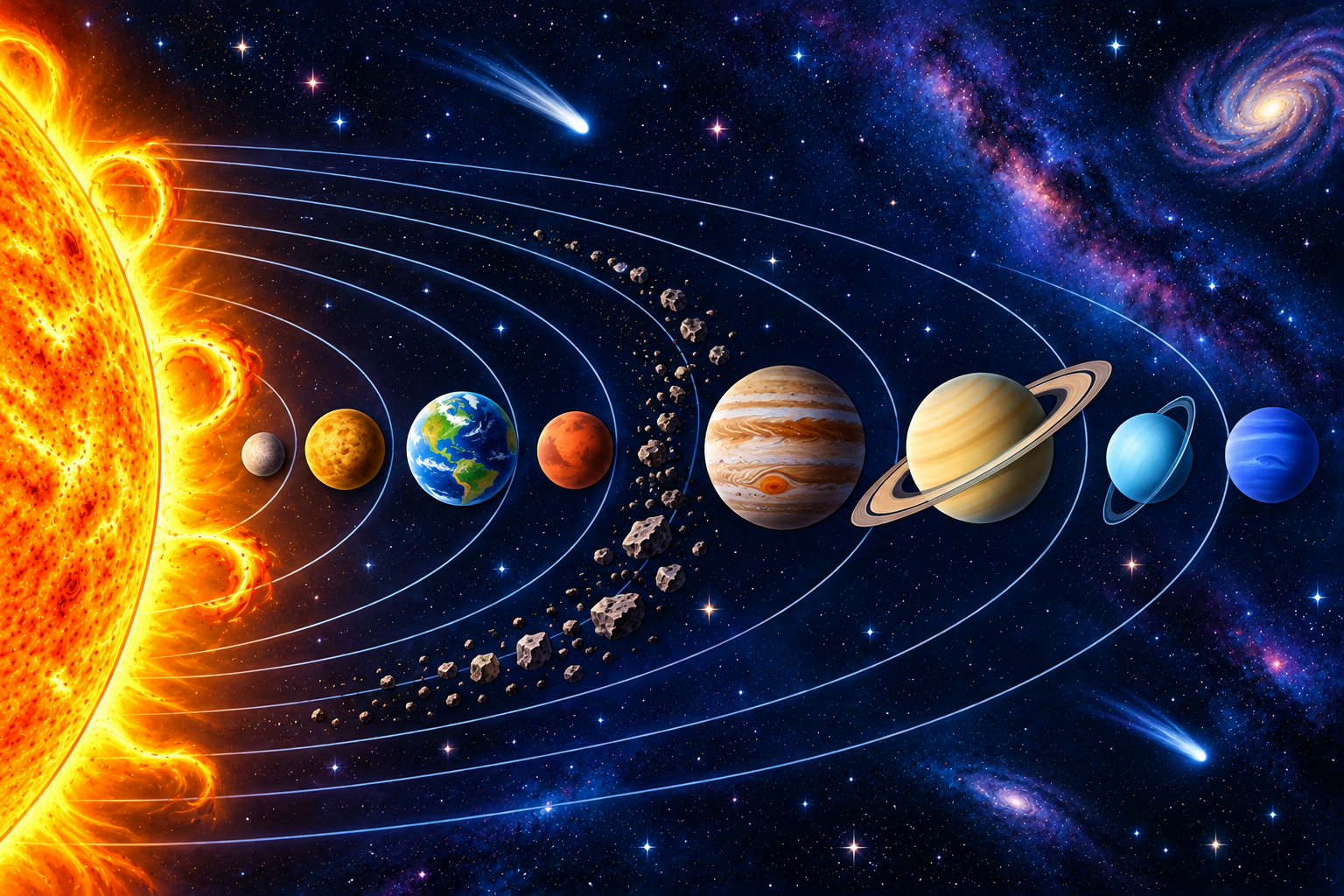
The Sun contains more than 99% of the total mass of our Solar System!
That means almost all the material in the Solar System is concentrated in our star.

The Sun and the Solar System
🤔 THINK LIKE A SCIENTIST
Imagine that the Sun suddenly became much less active.
What changes might we notice on Earth?
🌱 Would plants still grow normally?
☀️ Would Earth receive the same amount of energy?
🌦️ What might happen to our weather?
Think about it before moving on!
🚀 YOUR SUN DISCOVERY
The Sun isn’t simply a bright ball in the sky.
It is a giant, active star with layers, magnetic fields, storms, a powerful atmosphere and a constant stream of particles travelling through space.
And scientists are still discovering new things about our closest star. 🔭☀️
🌟 KEEP EXPLORING!
Next Discovery: 🌙 The Moon
🐛 KITABIKIDA
Learn • Explore • Imagine • Discover 📚✨